Russian Orthodox Church Protection of Mother of God
Russian Orthodox Church • Patriarchial Parishes in Canada

button ru_lang button eng_lang

Paschal Message by Patriarch KIRILL of Moscow and All Russia to the archpastors, pastors, deacons, monastics and all the faithful children of the Russian Orthodox Church.

Beloved in the Lord Most Reverend archpastors, all-honourable presbyters and deacons, God-loving monks and nuns, dear brothers and sisters:

CHRIST IS RISEN!

It is with these life-affirming words filled with great spiritual power that from the depths of my heart I greet and congratulate you all on the great and radiant feast of Holy Pascha.

It is not fortuitous that church tradition calls this day the “feast of feasts” and the “triumph of triumphs”, for Christ’s Resurrection is the solid foundation of our faith and hope. At the heart of it we find the transformation and renewal of every human being, the light of life everlasting and the fount of constant joy. Christ’s Resurrection has vanquished the most terrible enemies of the human race, which are sin and death, it has torn down the barrier between God and people and delivered us from the power of evil.

Glorifying the Resurrection of the Saviour, a Serbian saint, Bishop Nikolaj (Velimirović) of Ohrid and Žiča, wrote: “Christ’s victory is the sole victory in which all human beings can rejoice, from the first-created to the last. All other victories on earth have divided and continue to divide people… Yet only Christ’s victory can be likened to the sun pouring forth its bright rays upon all those who stand beneath it” (Conversations. The Gospel on the Vanquisher of Death).

This means that every human being who strives for salvation, every believer and follower of Christ, has been granted the opportunity to obtain victory over sin and become, as the Holy Apostle and Evangelist John says, one of the beloved “children of God” (1 John 3.1).

We celebrate Pascha not as a passage from one land to another, even a Promised Land, as the ancient Hebrews celebrated the Old Testament Passover, rejoicing in their liberation from the long years of Egyptian captivity. Our Pascha has a different meaning, for the Lord has delivered us from the “darkness of sin and the shadow of death” (Luke 1.79) and granted to us the kingdom of heaven.

“Out into the light of freedom did Christ lead the despondent captives; to the heavenly heights of Paradise led them He, rejoicing” (Hymn XXXVIII). These inspired words of Saint Ephrem the Syrian express our profound experience of the Paschal mystery, which is the mystery of salvation of the human person from the influence of evil. Evil has not disappeared, yet we have found a way, by the power of God’s grace, of combating and vanquishing it through repentance, prayer and through partaking of the Body and Blood of the Saviour in the sacrament of the Holy Eucharist. For this reason, we may affirm, along with the Apostle Paul, that “he who raised Christ from the dead will also give life to our mortal bodies because of his Spirit who lives in us” (Romans 8.11).

Christ’s Pascha heralds the passing over from earthly corruption to life eternal with God, to union with our Maker and Redeemer. Thus, as we rejoice in Jesus, who has risen for us, and with thanksgiving “lift up the cup of salvation” (Psalm 116.13) through which the Church gives us the true food and drink of immortality which is the Body and Blood of Christ, we shall tirelessly and without ceasing glorify the Lord with deeds of love and kindness, thereby showing ourselves to be his true disciples.

And although our striving for good and growth in God’s cause may at times seem to be the modest “widow’s mite” (Mark 12.42), let us always try to ensure that our strong faith and hope does not weaken, “because we know that in the Lord our labour is not in vain” (1 Corinthians 15.58).

Let us, then, render praise and glory to the Risen Saviour, let us embrace each other with love and let us share the unfading Paschal joy with every person whom God brings to us on our path through life, testifying in word and deed that

CHRIST HAS RISEN INDEED!

+KIRILL

PATRIARCH OF MOSCOW AND ALL RUSSIA 

Pascha

2025
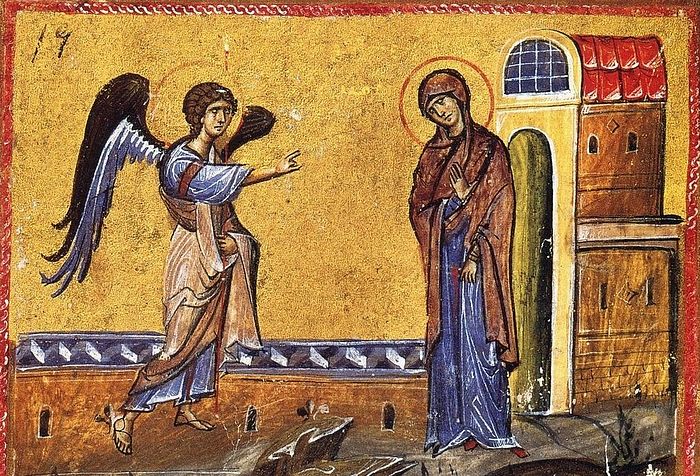

“Be It According to Thy Word”

The Annunciation of the Virgin.


The Annunciation is “the beginning of our salvation and the revelation of the mystery which is from eternity: the Son of God becometh the Son of the Virgin, and Gabriel proclaimed good tidings of grace” (Troparion of the Feast of the Annunciation). The divine will has been declared and proclaimed by the archangel. But the Virgin was not silent. She responded to the divine call, responded in humility and faith. “Behold the handmaid of the Lord; be it unto me according to thy word.”

“During the days of the creation of the world, when God uttered his living and mighty words: “Let there be,“ the Creator’s words brought creatures into existence. But on the day, unique in the existence of the world, when Holy Mary uttered her humble and obedient Let it be, I would hardly dare to express what took place then — the word of the creature caused the Creator to descend into the world. God uttered his word here also: You “will conceive in your womb and bear a son . . . he will be great . . . and he will reign over the house of Jacob for ever.” But again that which is divine and incomprehensible occurs–the Word of God itself defers its action, allowing itself to be delayed by the word of Mary: How can this be? Her humble Let it be was necessary for the realization of God’s mighty Let it be. What secret power is thus contained in these simple words: “Behold, I am the handmaid of the Lord; let it be to me according to your will” — that it produces an effect so extraordinary? This marvelous power is Mary’s pure and perfect self-dedication to God, a dedication of her will, of her thought, of her soul, of her entire being, of all her faculties, of all her actions, of all her hopes and expectations.” [Choix de Sermons et Discourse de S. Em. Mgr. Philarete, Metropolite de Moscow].


https://pravoslavie.ru/52745.html


The 100th anniversary of the repose of Saint Tikhon (Bellavin), Patriarch of Moscow and All Russia

Patriarch Tikhon’s Homily at His Enthronement Delivered in the Dormition Cathedral of the Moscow Kremlin, November 21, 1917 (excerpt)

“True, the Patriarchate is being restored in Rus’ during terrible times, amidst storms that tear mountains and crush rocks, amidst fire and death-dealing gunshots. … and at our fainthearted reproach: “O Lord, the sons of Russia have abandoned Thy commandments, destroyed Thine altars, shot at the churches and holy shrines of the Kremlin, and beaten Thy priests”—we can hear the still, small voice of God: “There are yet seven thousand men, who have not bowed their knees to Baal, nor betrayed the true God” (cf. 3 Kings: 19:10–12, 14, 18).

And the Lord as if says to me: Go and search out those for whose sake the Russian land yet stands and holds. But neither abandon the lost sheep condemned to destruction, to the slaughter—truly pitiful sheep. Shepherd them, and to this end take up this staff, the staff of good will (cf. Zach. 11:7). With it seek those who are lost, return those who were driven away, bind the broken, strengthen the sick; but destroy the fat and the strong, and feed them with judgment (cf. Ez. 34:16).” (Patriarch Tikhon (Bellavin), from: “In Times of God’s Wrath…”: Epistles, Homilies, and Speeches).

Patriarch Tikhon’s words have a special quality that is prophetic and God-inspired. It was living and relevant not only for his contemporaries, but for the whole Church, throughout all ages.

https://orthochristian.com/142958.html

https://orthochristian.com/108201.html


« 0 2 3 4 5 6 7 8 9 10 11 … 20 30 … 0 »