Russian Orthodox Church Protection of Mother of God
Russian Orthodox Church • Patriarchial Parishes in Canada

button ru_lang button eng_lang

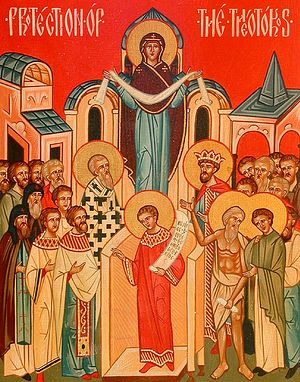
Homily on the Protection of the Most Holy Theotokos

Покров Пресвятой Богородицы


At the beginning of the tenth century, in year 910 after the birth of Christ, during the reign of the Greek Emperor Leo the Wise and Patriarch Tarasios, in the Blachernae Constantinople church, after the vigil the Mother of God and the angelic hosts appeared to the gaze of two chosen men. Covering the people there with her honorable Omophorion, she prayed to her Son and God for their salvation from the enemies that threatened the capital city with destruction, and the people with enslavement and death. Through the prayers of the heavenly Intercessor the foe was routed, and the people saved. In memory of the merciful protection of the Mother of the Lord also over our own fatherland, the Russian Orthodox Church has from ancient times established the yearly feast commemorating the Protection of the Mother of God.

The Protecting Omophorion is an image of maternal love. It should encourage us to turn to God with prayer. According to St. Ephraim the Syrian: The Queen of Heaven is our first and supreme Advocate with Her Son and God, our vigilant and unashamed Intercession, the Protection of the whole world, the Giver of all good things, our Consolation, Refuge, and Salvation.  Let us all run to her powerful protection with pure hearts when we are beset by attacks, sorrows, and sicknesses, and trust in her undoubted hope. Amidst the calamities of life let us prepare ourselves to go to the place where there are no troubles, where there is eternal joy and rest. And the Heavenly Queen will take pleasure in helping us and protecting us from misfortunes, and she will instruct us toward the eternal, peaceful heavenly harbor. O Lady, cover us with your honorable protecting veil, and deliver us from all evil, praying to your Son, Christ our God to save our souls! Amen.

St. John of Kronstadt (1893)


https://orthochristian.com/163884.html


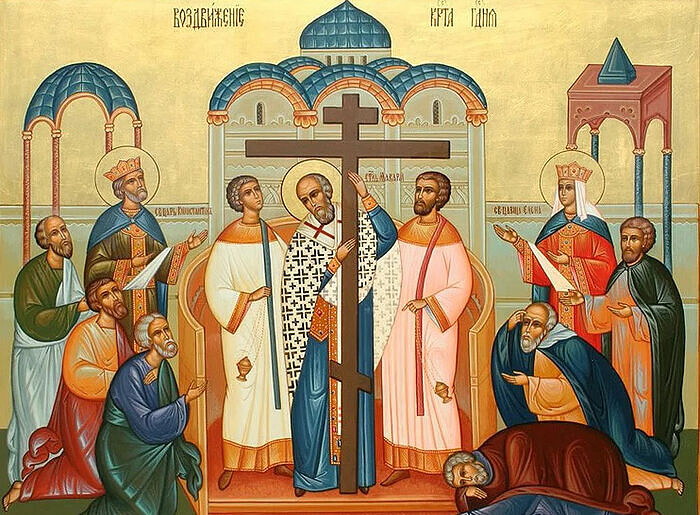
The Exaltation of the Honorable and Life Giving Cross of the Lord_27 September

History of the Feast

In the first centuries of Christianity, during the years of persecution, the pagans wished to destroy all evidence of the life of Jesus Christ, and the Cross on which He was crucified disappeared. With the conversion of Emperor Constantine the Great, Christians were at liberty to worship openly and build churches. The emperor’s mother, St. Helen, longed to find the True Cross of Christ. She traveled to Jerusalem and was told by a very old Jew that the Cross was buried beneath the temple of the pagan goddess Venus, built in 119 AD by the Roman Emperor Hadrian.

The temple was torn down, and digging in the earth below uncovered three wooden crosses. The small board which had hung over Christ with the inscription ‘ Jesus King of the Jews,’ had long since fallen off, and -there was no way of telling which was the True Cross and which were the crosses of the two thieves crucified on either side of Christ. A sick woman was brought and likewise a dead man who was being carried to burial. The three crosses were laid in turn one by one upon the sick woman and upon the dead man. Two of the crosses had no effect, but through contact with the third cross, the sick woman was healed of her infirmity and the dead man came to life. These miracles clearly indicated which of the three was Christ’s Cross.

Hearing of this discovery, all the faithful desired to see the Cross of the Lord and to venerate it. The Patriarch of Jerusalem, Makarios, took the Cross onto a raised platform and lifted it on high, ‘exalting’ it, for all to see. The people fell to their knees, bowing down before the Cross and crying out repeatedly: “Lord, have mercy!”

To house the relic of the True Cross, St. Helen had s church built over the Holy Sepulchre. The church was consecrated on Sept. 13, 335, an event also commemorated in the service hymns of the Feast. The finding and exaltation of the Cross was appointed to be celebrated annually on the following day.


https://orthochristian.com/64407.html


The Apostles Fast (June 16 – July 11)

“This summer fast, which we now call the Apostles fast, was earlier called the fast of Pentecost.

“After the extended feast of Pentecost, the fast is particularly needed in order to cleanse our mind by ascetic labors, and to make us worthy of the gifts of the Holy Spirit,” writes St. Leo the Great. “After the present feast, which the Holy Spirit has sanctified by His descent, all the people usually keep a fast beneficially established for the healing of soul and body, and therefore requiring that we spend it with the appropriate reverence. For we do not doubt that after the Apostles’ hearts were filled with the Spirit of truth promised to them from on high, amongst the other mystical heavenly teachings given by their Teacher, they were given also the teaching on spiritual continence, so that their hearts, purified by fasting, would be made capable of receiving gifts of grace… It is would not be possible to struggle in a pampered body and fattened flesh against the persecutions, and the fierce threats of the ungodly that lay ahead; for that which delights our outer man destroys our inner man, and the more a wise soul mortifies its flesh, the purer it becomes. … In the Apostolic canons inspired by God Himself, the Church fathers have, at the inspiration of the Holy Spirit, established first and foremost that all virtuous labors begin with fasting.”

Blessed Simeon of Thessalonika writes that the fast was established in honor of the Apostles, because we have been vouchsafed many blessings through them, and they have been shown to us as doers and teachers of fasting, obedience… and temperance. “


Source: https://orthochristian.com/47148.html


1 2 3 4 5 6 7 8 9 10 20 30 0 »