Russian Orthodox Church Protection of Mother of God
Russian Orthodox Church • Patriarchial Parishes in Canada

button ru_lang button eng_lang

PASCHAL MESSAGE FROM PATRIARCH KIRILL OF MOSCOW AND ALL RUSSIA

God-loving monks and nuns, dear brothers and sisters,

I address all of you, Orthodox Christians living in many countries of the world, who are now in churches or praying in your homes, to extend greetings to you on the great feast of Holy Pascha with my heart full of spiritual joy, and to proclaim victoriously in accord with the ancient tradition:

CHRIST IS RISEN!

It is in these very words that the Holy Church has been triumphantly proclaiming the glad tidings of the God-given salvation for two thousand years. In them is the fire of our faith, the strength of love, the foundation of hope, the cornerstone of the Church, the heart of the New Testament message to the world, the unfading light of enlightenment and the source of inspiration, the core of Christian life and our entire future.

Whatever happens in our ever-changing, sometimes restless and conflict-torn world, whatever hardships and ordeals befall us, we know, believe and preach that the Paschal joy in the Risen Saviour remains unfailing and all-victorious.

What is the meaning of this greatest Christian feast? In the name of what and why did the Son of God come down to earth, take the form of a servant (Phil 2:7), endure sufferings, being crucified on the cross, and rise from the dead? And what do we, people of the 21st century, have to do in order to become true partakers and heirs of Christ’s victory over death?

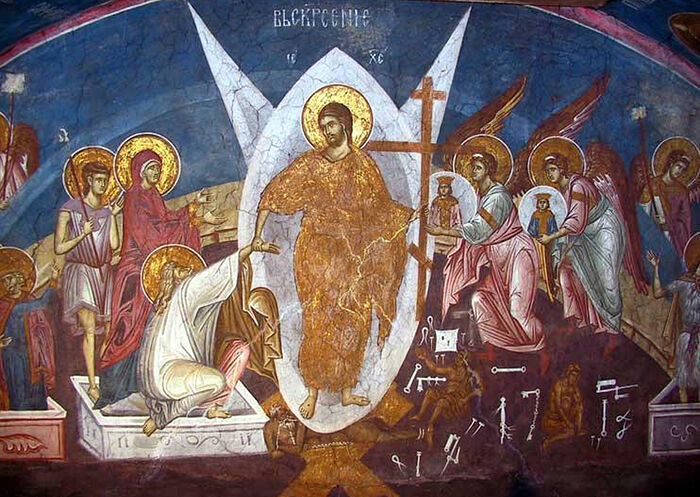
The Church gives us answers to these questions, bearing witness that through the Son of God Who was incarnate of the Most Blessed Virgin hell is led captive, Adam is recalled from the dead, the curse is made void, Eve is set free, death is slain, and we are endowed with life (Sunday Theotokion, Stichera at the Praises, tone 2). Truly, the Lord quickens us by His love, delivers us from the fear of death and corruption, heals our spiritual and bodily infirmities, supports us in hardships and trials, comforts in afflictions and sorrows, and helps us follow the path of salvation leading to eternal life when God will wipe away every tear from [people’s] eyes, and death shall be no more, neither shall there be mourning nor crying nor pain any more (Rev 21:4).

Having performed the feat of redemption, through His sacrifice on the cross and glorious Resurrection the Lord opened the gates of heaven to everyone. From then on and to this day, every human being is given an opportunity to wholeheartedly embrace Christ as the true God and Saviour Who grants blessed strength for leading a life of righteousness and actively participating in the transfiguration of the world.

Reflecting on the feast of Easter, Saint Nicholas of Serbia, a prominent theologian of the past century, wrote, Christ is risen – it means that life is stronger than death. Christ is risen – it means that good is stronger than evil. Christ is risen – it means that all difficulties in life are resolved (Thoughts on Good and Evil). And this Paschal joy, which is the joy of communion with God and of building up a new life (Rom 6:4) on the basis of goodness and justice, touches the hearts of millions of Christians, inspiring them to do works of charity and mercy, helping to overcome adversities, comforting them in ordeals, giving hope to the desperate and strengthening the faint-hearted.

On the radiant feast of Pascha our special prayers are offered to God for people in combat zones. We as Christians cannot remain indifferent to the troubles and hardships of our brothers and sisters whose hearts are seared by the fire of internecine strife. So we lift up our fervent supplications unto the Lord that by His mercy and loving-kindness He may heal bodily and, above all else, spiritual wounds, give comfort in every sorrow and grant a lasting and just peace to the brotherly peoples that came from one Dnieper baptismal font.

The earthly life of the Saviour was full of labour and sacrificial love for people, and we are called to become like Him in serving our neighbours, since any, even the smallest virtue, every effort to overcome our own selfishness for the sake of another person, draws us closer to God – the Source of life and immortality – and therefore makes us happier.

May the Risen Lord Who in accord with His truthful promise abides with His followers even unto the end of the world (Mt 28:20) vouchsafe us, sinful and infirm, but thirsting for righteousness and seeking salvation, to inherit the blessed life after we complete our earthly journey, so that in the Heavenly mansions prepared… from the foundation of the world (Mt 25:34) we together with saints reign in His eternal glory (St Ambrose of Milan, Hymn “We Praise Thee, O God”). This joyful anticipation of the Kingdom of love to come, of God being everything to every one (1 Cor 15:28) is what the Church preaches at all times and even more so in the radiant Easter season.

Let us hearken to the salvific voice of the Church calling us through the Holy Apostle Paul to celebrate Pascha not with the old leaven, the leaven of malice and evil, but with the unleavened bread of sincerity and truth (1 Cor 5:8). Let us heed and try to live according to the Divine commandments, by the truth of the Gospel, our good deeds and our whole life bearing witness before those near and those far away that Christ is risen indeed, unto Whom are due all glory, honour and worship unto the ages of ages. Amen.

+KIRILL
PATRIARCH OF MOSCOW AND ALL RUSSIA

Easter
2023

Source: https://orthochristian.com/153154.html

Holy Week

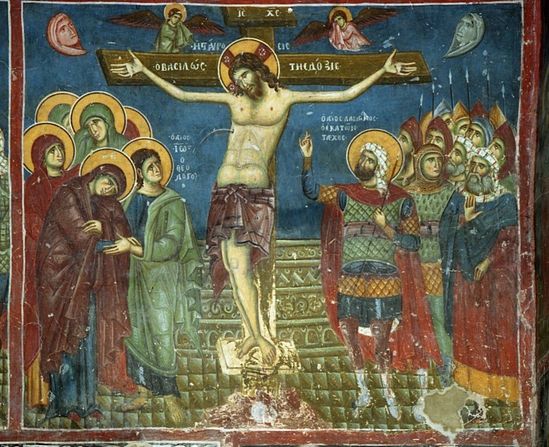
Великая Пятница. Распятие. Фреска церкви св.Николая в Прилепе, Македония. XII-XIII в.

Great Lent and Holy Week are two separate fasts, and two separate celebrations. Great Lent ends on Friday of the fifth week (the day before Lazarus Saturday). Holy Week begins immediately thereafter. Let’s explore the meaning of each of the solemn days of Passion Week.

Holy Monday, Tuesday and Wednesday: The first thing that must be said about these services, and most of the other services of Holy Week, is that they are “sung” in anticipation. Each service is rotated ahead twelve hours. The evening service, therefore, is actually the service of the next morning, while the morning services of Holy Thursday and Holy Saturday are actually the services of the coming evening.

Understanding that, let’s turn to the Services of Holy Monday, Tuesday and Wednesday (celebrated Palm Sunday , Monday and Tuesday evening). The services of these days are known as the Bridegroom or Nymphios Orthros Services. At the first service of Palm Sunday evening, the priest carries the icon of Christ the Bridegroom in procession, and we sing the “Hymn of the Bridegroom.” We behold Christ as the Bridegroom of the Church, bearing the marks of His suffering, yet preparing a marriage Feast for us in God’s Kingdom.

Each of these Bridegroom Orthros services has a particular theme. On Holy Monday, the Blessed Joseph, the son of Jacob the Patriarch, is commemorated. Joseph is often seen as a Type of Christ. Joseph was betrayed by his brothers, thrown into a pit, and sold into slavery by them. In the same way, our Lord was rejected, betrayed by His own, and sold into the slavery of death. The Gospel reading for the day is about the barren fig tree, which Christ cursed and withered because it bore no fruit. The fig tree is a parable of those who have heard God’s word, but who fail to bear the fruit of obedience. Originally the withering of the fig tree was a testimony against those Jews who rejected God’s word and His Messiah. However, it is also a warning to all people, in all times, of the importance of not only hearing the God’s word, but putting it into action.

The Parable of the Ten Virgins is read on Holy Tuesday. It tells the story of the five virgins who filled their lamps in preparation for receiving the bridegroom while the other five allowed their lamps to go out, and hence were shut out of the marriage feast. This parable is a warning that we must always be prepared to receive our Lord when He comes again. The theme of the day is reinforced by the expostelarion hymn we sing: “I see Thy Bridal Chamber adorned, O my Savior, but have no wedding garment that I may enter. O Giver of Light, enlighten the vesture of my soul, and save me.” The theme of Holy Wednesday is repentance and forgiveness. We remember the sinful woman, Kassiane, who anointed our Lord in anticipation of His death. Her repentance and love of Christ is the theme of the wonderful “Hymn of Kassiane” which is chanted on this night, reminding us one more time, before “it is too late,” that we too may be forgiven if we repent.

Holy Unction: The Mystery or Sacrament of Holy Unction is celebrated on Holy Wednesday evening. Actually this service can be celebrated any time during the year, especially when one is ill. However, because of our need for forgiveness and spiritual healing, we offer this service during Holy Week for the remission of our sins. We should prepare for this service in a prayerful way, as we do for Holy Communion.

Great and Holy Thursday: On Holy Thursday we turn to the last events of our Lord and His Passion. Thursday morning begins with a Vesperal Divine Liturgy commemorating the Mystical Supper. As previously mentioned, this is actually Holy Thursday evening’s service celebrated in the morning in anticipation. Everyone who is able should make an effort to receive Holy Communion at this service as it was at the Mystical Supper that our Lord instituted the Holy Eucharist. At this Liturgy a second Host is consecrated and kept in the Tabernacle. It is from this Host that Holy Communion is distributed to the shut-ins and the sick throughout the coming year.

Thursday evening actually begins the services of Great and Holy Friday. The service of the Twelve Passion Gospels commemorates the solemn time of our Lord’s Crucifixion. After the reading of the fifth Gospel, the holy cross is carried around the church in procession, and Christ’s body is nailed to the cross in the center of the church. 

Great and Holy Friday: This is a day of strict fast. As little as possible should be eaten on this day. It is the only day in the entire year that no Divine Liturgy of any kind can be celebrated. In the morning we celebrate the Royal Hours. These solemn hours are observed as we read the various accounts and hymns concerning the crucifixion. In the afternoon we celebrate the Vesper service of the taking down of Christ’s body from the cross. During the Gospel reading, our Lord’s body is taken off the cross and wrapped in a new, white linen sheet. This act commemorates the removal of Christ’s body from the cross by Joseph of Arimathea (John 19:38-42). Later in the service, the Epitaphios, or winding-sheet, with Christ’s body on it is carried in procession and placed in the recently decorated tomb. In the evening the Lamentations Orthros service is sung. This service begins in a solemn manner, but by the end of the service we are already anticipating the Resurrection of our Lord. Remember again, that the Holy Friday evening Orthros is actually the first service of Holy Saturday, the day in which we commemorate our Lord’s body resting in the tomb while His all-pure soul descends into Hades to free the faithful of the Old Covenant.

Great and Holy Saturday: This day is a day of hope and waiting. In the morning we celebrate a Vesperal Divine Liturgy which commemorates Christ’s victory over death. Bright vestments are worn as we anticipate Christ’s Resurrection. Laurel leaves are strewn throughout the church during the service, because in the ancient world laurel leaves were a sign of victory. As the leaves are strewn, the choir chants “Arise O God and Judge the earth, for to Thee belong all the nations.” The Old Testament story of Jonah in the belly of the whale is read at this service because Jonah is seen in the Church as a Type of Christ. As Jonah was three days in the belly of the great fish, and was then safely deposited back onto land, so our Lord was three days in the tomb before His glorious Resurrection. The Vesperal Divine Liturgy of Holy Saturday concludes the services of Holy Week, and brings us to the eve of Great and Holy Pascha.

Source: https://orthochristian.com/61187.html


Great Lent. 1st Week of Great Lent

Photo: media.elitsy.ru

The first week of Great Lent is a time of special prayer and strict abstinence. During the first four days—from Monday to Thursday—the Great Canon of Repentance of St. Andrew of Crete is read in nearly every Orthodox Church.

The great Canon of St Andrew, Bishop of Crete, is the longest canon in all of our services and is associated with the initial stages of the spiritual journey of great Lent. There is no other sacred hymn which compares with this monumental work, which St Andrew wrote for his personal meditations. Nothing else has its extensive typology and mystical explanations of the scripture, from both the Old and New Testaments. One can almost consider this hymn to be a “survey of the Old and New Testament”. It’s other distinguishing features are a spirit of mournful humility, hope in God, and complex and beautiful Trinitarian Doxologies and hymns to the Theotokos in each Ode.

St Andrew wrote the Canon to challenge the faithful spiritually. For Eastern Orthodox, all spiritual exercises are designed to heighten our perception of basic reality: Sin is much more serious than we think, and God’s forgiveness is much more vast than we think. Left to ourselves, we go around with Playskool impressions of what’s at stake. So the goal of all spiritual disciplines are to cultivate charmolypi — to use a Greek term coined by the 6th-century abbot of the monastery on Mt Sinai, St. John of the Ladder. Charmolypi means the kind of penitence that flips into joyous gratitude, “joy-making sorrow,” repentance shot through with gold.
There is a tone of awe and mystery that runs throughout its expression — a sense ofseriousness and urgency for the restoration from the old Adam to the new Adam based on the incarnation. The great Canon provides the faithful with the tools not only to approach God but more importantly, to unite with Him. Its main theme is: repentance, the return form sin or theunity of the cosmos and the human race – as one creation united in love – to its Creator. The great Canon invites the faithful to utilise all aspects of their existence including all their senses to communicate with their Creator, in order to live with Life itself. For this reason St Andrew’s Canon contains both anthropological and cosmological themes, which include:

How we should think about ourselves:

Where shall I begin to lament the deeds of my wretched life? What first-fruit shall I offer, O Christ, for my present lamentation? But in Thy compassion grant me release from my falls Mon:1.1

Desire to change – dialogue with the soul:

Come, wretched soul, with your flesh, confess to the Creator of all. In the future refrain from you former brutishness, and offer to God tears of repentance Mon:1.2

Recognizing Reality:

The end is drawing near, my soul, is drawing near! But you neither care nor prepare. The time is growing short. Rise! The Judge is at the very doors. Like a dream, like a flower, the time of this life passes. Why do we bustle about in vain? Mon:4.2

How to pray – Laments and supplications to God:

Thou art the Good Shepherd; seek me, Thy lamb, and neglect no me who have gone astray Mon:3.5

Examples of righteousness and unrighteousness, for the purpose of emulation or avoidance:

Do not be a pillar of salt, my soul, by turning back; but let the example of the Sodomites frighten you, and take refuge up in Zoar. (Genesis 19:26) Thu Ode 3:5

I have reviewed all the people of the Old Testament as examples for you, my soul. Imitate the God-loving deeds of the righteous and shun the sins of the wicked. Tue Ode 8

Therefore the function and purpose of the great canon is to reveal sin to us and to lead us thus to repentance, and it reveals sin not by definitions and enumerations but by a deep mediation on the great biblical story which is indeed the story of sin, repentance and forgiveness. It indicates to us the revealed Biblical world-view of humanity, of its life, its goals, and its motivation. It helps us to see that sin is first of all the rejection of life as offering/sacrifice to God; in other words sin is the rejection of the divine orientation of life, sin is therefore the deviation of our love from its ultimate object and subject, the presence of God, God Himself. By offering us this deeper realization about ourselves and our life, the great canon restores in us the fundamental framework within which repentance again becomes possible, having now found the true dimension of our life by its guidance.


Source of information: https://orthochristian.com/60910.html


« 0 10 11 12 13 14 15 16 17 18 19 20 30 0 »